
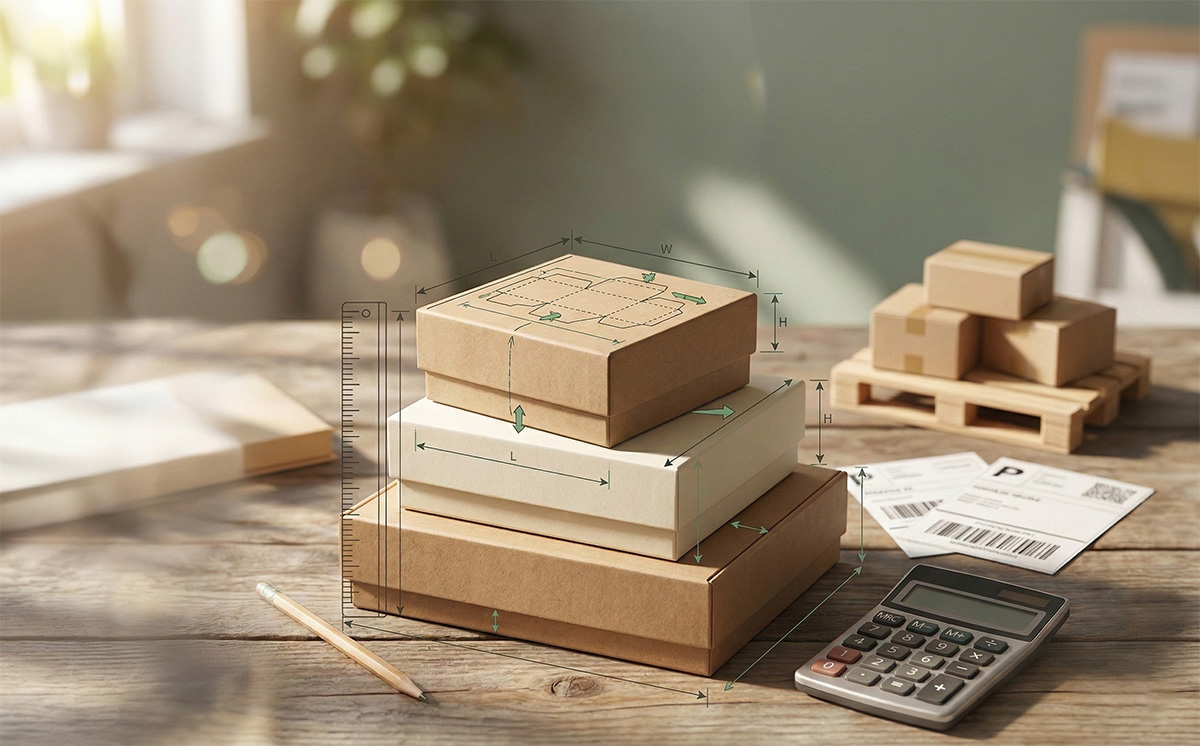
Premium rigid boxes (also known as setup boxes) are the undisputed kings of luxury packaging. High-end skincare serums, flagship smartphones, and boutique spirits rely on the satisfying weight and unyielding structure of a rigid box to communicate brand value before the product is even touched.
But this premium unboxing experience comes with a brutal supply chain reality: Rigid boxes cannot be folded flat. When you import 20,000 standard rigid boxes, you are essentially paying international freight rates to ship 80% empty air.
For brands scaling globally, standard rigid packaging often results in crushed profit margins and warehouse nightmares. Let's look at the data on how Value Engineering (VE) is redefining the rigid box.
Value Engineering (VE) Impact Snapshot
Freight Volume Saved
Achieved by transitioning from traditional two-piece setups to collapsible magnetic structures, drastically cutting ocean freight and warehouse footprint.
Material Cost Drop
Realized through precise greyboard GSM optimization and V-grooving technology, maintaining structural integrity with less raw material.
Pallet Utilization
Secured by implementing a Pallet-First dimensioning strategy, ensuring primary boxes perfectly fit master cartons without transit overhang.
1. The Problem of Shipping "Air" (The Freight Multiplier)
A standard two-piece rigid box (lid and base) is manufactured fully assembled. If your product launch requires 50,000 units, the sheer cubic volume (CBM) will mandate multiple 40HQ ocean containers. Furthermore, storing these empty boxes at your fulfillment center consumes massive amounts of expensive warehouse racking space.
How TM&HT Solves This: The Collapsible Rigid Box
We re-engineer traditional setups into Magnetic Collapsible Rigid Boxes. These boxes use the exact same premium 1200gsm greyboard and luxury wrapping papers, but feature engineered hinges and concealed magnets. They ship completely flat—reducing shipping volume by up to 80%. When your fulfillment team pops them open, the magnets snap the walls into a perfect 90-degree rigid structure indistinguishable from a standard setup box.
2. The Trap of "Over-Engineering" (Greyboard GSM)
Many brands mistakenly equate "thicker cardboard" with "higher quality." It is common to see procurement requests for 1500gsm or even 1800gsm greyboard for small cosmetics boxes. This over-engineering drastically increases the raw material cost, adds unnecessary weight to the final shipment, and actually makes the box harder to wrap flawlessly.
- The Structural Reality: A box's crush resistance does not rely solely on the thickness of the board. It relies heavily on the sharpness of the corners and the structural integrity of the wrapping paper tension.
How TM&HT Solves This: Value Engineering (VE)
Our structural engineers perform a thorough Value Engineering (VE) audit on your current design. We typically reduce greyboard thickness from 1500gsm to a highly optimized 1000gsm-1200gsm. To maintain the "premium feel" and structural rigidity, we use:
- V-Groove Cutting: Instead of half-cutting the board, we use precision V-groove machinery. This creates razor-sharp, 90-degree luxury corners that reinforce the box's structural integrity, allowing us to use lighter, more cost-effective boards without sacrificing the high-end aesthetic.
3. Pallet-First Dimensioning (The Supply Chain Blind Spot)
A beautiful box is a failure if it arrives crushed. Often, graphic designers dictate the final dimensions of a rigid box based purely on aesthetics. However, if those dimensions do not divide evenly into standard Master Cartons, and those cartons do not fit perfectly onto a standard ISO or US shipping pallet, two things happen:
- Wasted Space: Gaps in the master carton or pallet overhang lead to paying for unused space.
- Transit Damage: Pallet overhang is the #1 cause of crushed corners during ocean and truck freight.
How TM&HT Solves This: Reverse Supply Chain Design
We design from the outside in. Before finalizing your primary retail box, we calculate the exact dimensions of the protective shipper, the master carton, and the palletization pattern. Adjusting a retail box by just 5 millimeters can sometimes allow us to fit an extra 30 boxes per layer on a pallet. This Pallet-First methodology guarantees 100% spatial efficiency and drastically reduces transit damage rates.
"Great packaging design isn't just about how it looks on the retail shelf; it's about how efficiently it travels across the ocean to get there."
The Bottom Line
You don't need to sacrifice your brand's luxury positioning to improve your profit margins. By applying structural engineering principles—such as collapsible designs, V-groove optimization, and pallet-first dimensioning—brands can unlock massive hidden savings within their supply chain.